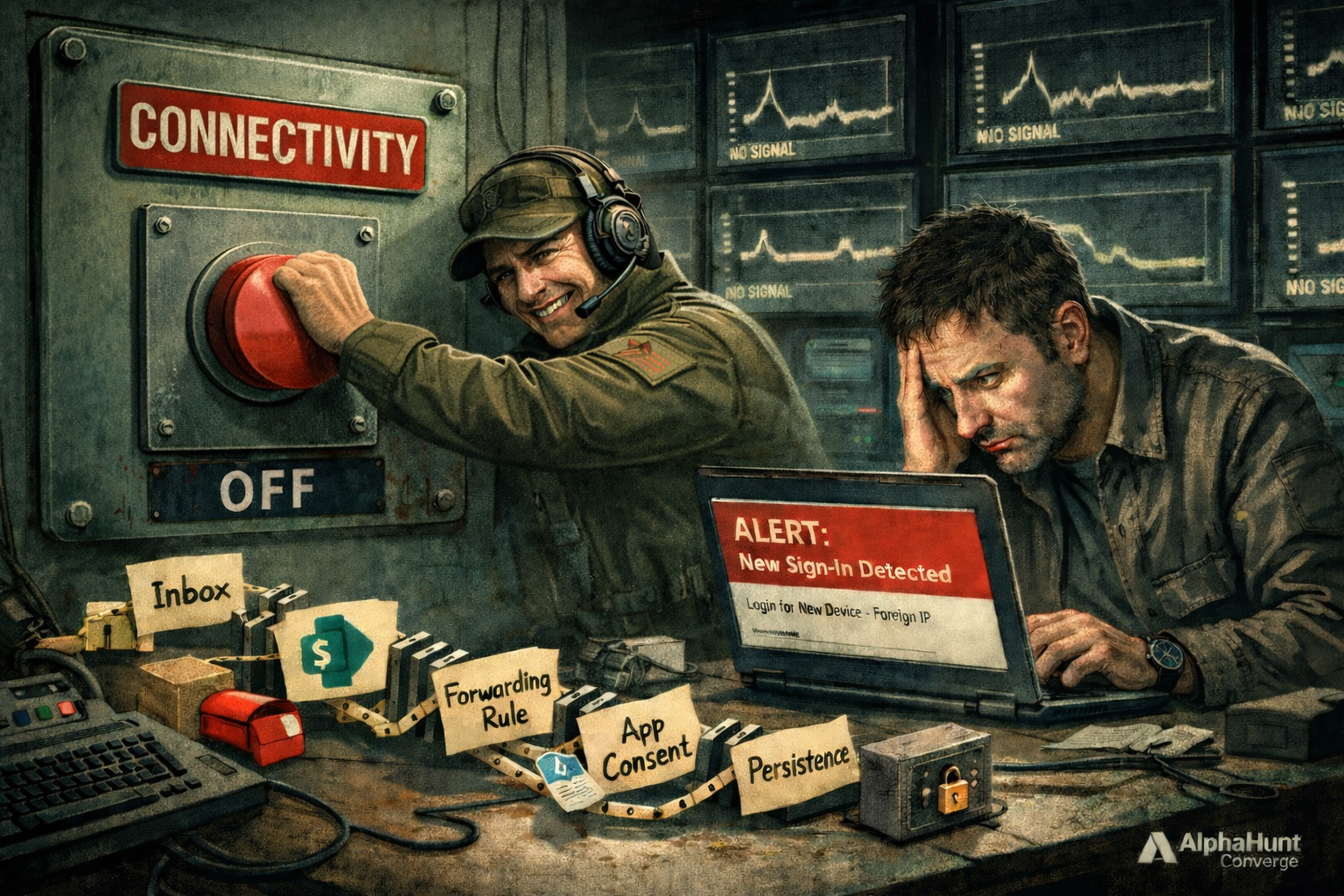
[GAME THEORY] The Help Desk Is Becoming the New Intrusion Broker
![[GAME THEORY] The Help Desk Is Becoming the New Intrusion Broker](https://images.squarespace-cdn.com/content/v1/54bd1221e4b05e8a3646d021/1788199942638-WAOVUTKSXMH2CGES7JA5/alphahunt-game-theory-the-help-desk-is-becoming-the-new-intrusion-broker-hero-2026-08-31.png)
Vishing works because urgency can become SaaS authority. Break the trust transaction without breaking support.
Vishing works because urgency can become SaaS authority. Break the trust transaction without breaking support.
Device-code phishing turns a legitimate login flow into rented access. The durable defense is to shrink who can use it.
Everyone loves a “trusted app” until it turns into a long-lived permission slip with better branding.
The platform can stay technically unbroken and you still get cleaned out. That gap is the problem.
Everyone saw the PLC headline and immediately built their whole Iran take around exposed controllers. Cool. The nastier question is what happens when the next move comes through identity, admin planes, or some target class nobody staffed for.
Iran cyber risk isn’t just “watch for wipers.” It’s the same ugly identity-first playbook: password sprays, MFA abuse, cloud access… then maybe admin-plane sabotage. Recent reporting says activity is already reaching U.S. targets. Cute. 🚨🔐🧨
Ransom is a tactic. Liquidity is the strategy.
Our new forecast asks: will ShinyHunters make more in 2H 2026 by selling SaaS access/data than by getting paid? Signals say yes. 🕵️♂️💸☁️
Iran’s internet goes dark → attackers don’t stop. They speed-run creds and hit post-auth collection the moment connectivity blips back. ⏱️🔑👀
![[GAME THEORY] The Phish Did Not Steal the Password. It Rented the Protocol.](https://images.squarespace-cdn.com/content/v1/54bd1221e4b05e8a3646d021/1785515370852-RA602VHIBOG63AZR134K/alphahunt-game-theory-the-phish-did-not-steal-the-password-it-rented-the-protocol-hero-2026-07-31.png)
![[FORECAST] Two New App-Layer Campaigns by Year-End? Watch the Attribution Line](https://images.squarespace-cdn.com/content/v1/54bd1221e4b05e8a3646d021/1776203717501-9CVN1LJYDQLAPKU90H7R/z.png)
![[FORECAST] Beyond PLCs: Are Iran-Linked Operators More Likely to Chase New Targets, New Tooling, or New Impact? UPDATED 2026-04-08!](https://images.squarespace-cdn.com/content/v1/54bd1221e4b05e8a3646d021/1775677258908-F0SXWFIDAWO0IXFL7E4S/z.png)
![[FORECASTS] From Password Sprays to Tenant Sabotage: The 8-Week Iran Cyber Risk for U.S. and Israeli Orgs](https://images.squarespace-cdn.com/content/v1/54bd1221e4b05e8a3646d021/1773672177786-ETLYZK0QIPMLI49ANREA/z.png)
![[FORECAST] ShinyHunters SaaS Data Theft: Why Non-Ransom Monetization Looks Increasingly Attractive](https://images.squarespace-cdn.com/content/v1/54bd1221e4b05e8a3646d021/1770053581353-COX4JWQFSYW6WFHYQYME/z.png)