[DEEP RESEARCH] A Refrigeration Maintenance Contract Should Survive Losing Its Connection
![[DEEP RESEARCH] A Refrigeration Maintenance Contract Should Survive Losing Its Connection](https://images.squarespace-cdn.com/content/v1/54bd1221e4b05e8a3646d021/1792435175014-WZY60AR74N2FSSVA0YCD/alphahunt-deep-research-who-owns-the-cold-chain-when-the-controller-goes-online-hero-2026-10-19.png)
French refrigeration hacks expose a maintenance gap: prove safe settings, controlled access and recovery before renewal.
French refrigeration hacks expose a maintenance gap: prove safe settings, controlled access and recovery before renewal.
Shared intrusion logistics can be a better chokepoint than one APT—if defenders can prove real control-plane dependence.
Industrial incident reporting often gives analysts the loudest facts first: ransomware branding, a production halt, and a statement that no physical impact was confirmed. Those facts matter, but they do not answer the harder question—what did the adversary learn about the process?
A firewall, VPN, or secure-access gateway can hold much more than vulnerable code. It can mediate trusted sessions, store service-account credentials, expose configuration secrets, and connect external identities to internal systems. Once those artifacts leave the appliance, remediation becomes a trust-recovery problem—not only a software-maintenance task.
China-linked operators are turning compromised routers into relay logistics. The defender move is behavior over bad IPs.
The forecast likely resolves No, but the useful lesson is where Iran-linked operators still depend on access defenders can pressure.
The forecast is stubborn.
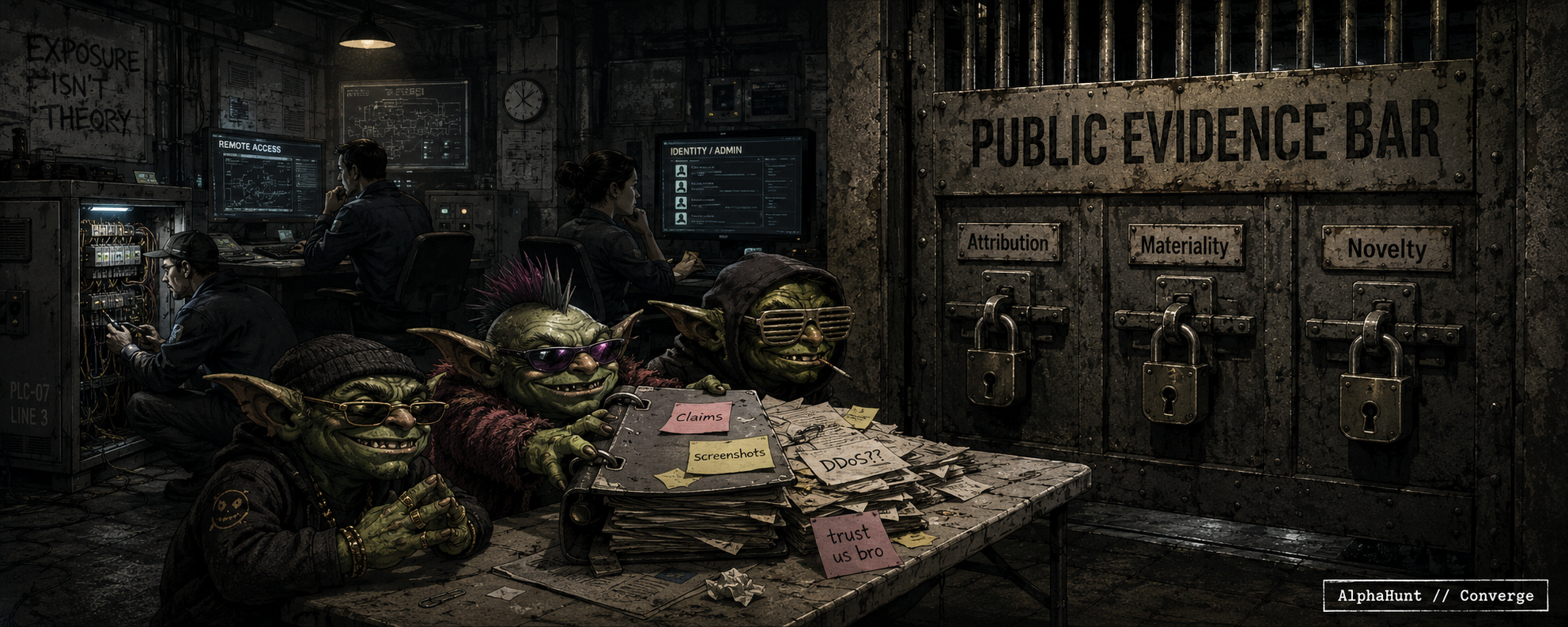
Iran-linked PLC activity is real. The harder part is proof: numbers, attribution, novelty.
Noise is not qualification.
![[GAME THEORY] The Quartermaster Is the New Intrusion Broker](https://images.squarespace-cdn.com/content/v1/54bd1221e4b05e8a3646d021/1788873067991-YLM2NI0UG4RVDV90IIHY/alphahunt-game-theory-the-quartermaster-is-the-new-intrusion-broker-hero-2026-09-08.png)
![[DEEP RESEARCH] The OT Signal Is What the Defender Could Not See](https://images.squarespace-cdn.com/content/v1/54bd1221e4b05e8a3646d021/1785774805195-B583VUXDEW95V6U5LGMK/alphahunt-deep-research-the-ot-signal-is-what-the-defender-could-not-see-hero-2026-08-03.png)
![[FORECAST] The Patch Can Close While the Access Stays Open](https://images.squarespace-cdn.com/content/v1/54bd1221e4b05e8a3646d021/1784573430853-285APB8NK09QNQUQ05QW/alphahunt-forecast-the-breach-may-start-after-the-patch-hero-2026-07-20.png)
![[FORECAST] Residential IPs are not enough evidence to call something noise](https://images.squarespace-cdn.com/content/v1/54bd1221e4b05e8a3646d021/1783695979178-GCO3EEPYR2H97LSL48AM/alphahunt-orb-relay-networks-hero-2026-07-10.png)
![[FORECAST] Iran Cyber Is Active. The Evidence Bar Is Harder.](https://images.squarespace-cdn.com/content/v1/54bd1221e4b05e8a3646d021/1778696857364-AVRHX3XKXJ0MP943CHJA/zz.png)